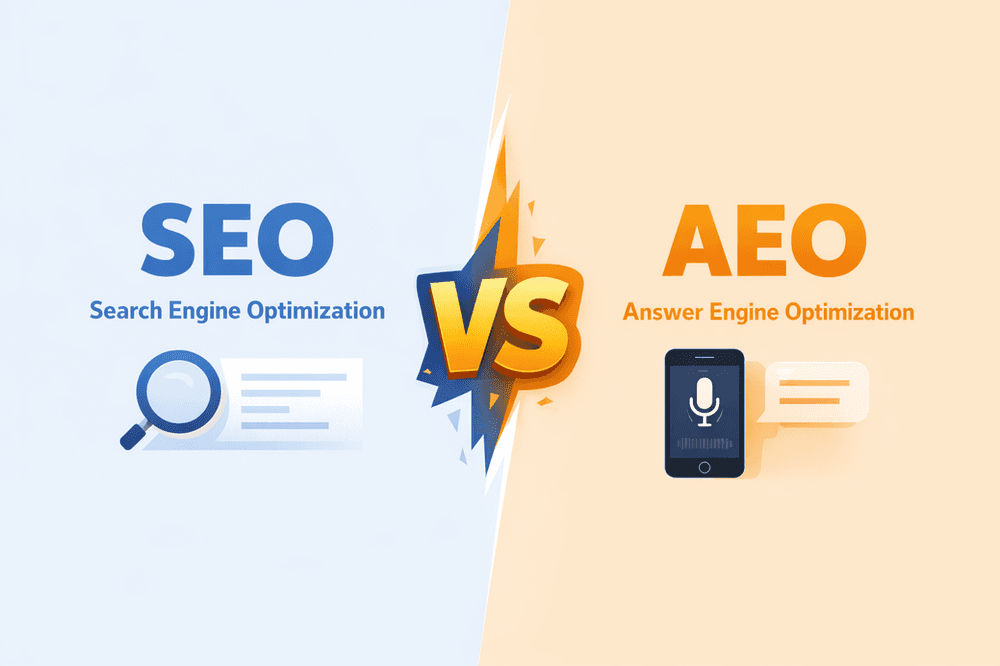
AEO overlaps with SEO at the foundation, but the signals, measurement methods, and workflows that drive AI visibility are different enough to make it a distinct discipline.
A genuine question is circulating in marketing leadership right now: is Answer Engine Optimization a genuinely new discipline, or is it SEO with a new coat of paint?
It's a fair thing to ask. Experienced SEO practitioners point out, correctly, that content quality, technical hygiene, and brand authority matter in both traditional search and AI-generated responses. The fundamentals haven't disappeared. And the industry has seen enough rebranding exercises to be skeptical of new terminology.
At the same time, a growing body of data and a formal guide from Microsoft suggest the two disciplines diverge in ways that matter operationally. For CMOs, the practical question isn't theoretical: does AEO belong inside the SEO function, or does it require a separate mandate with different signals, tools, and measurement? We've looked at the evidence on both sides. Here's what it actually says.
The case for "it's the same thing"
The skeptics aren't wrong about everything. The overlap between strong SEO and strong AEO is real.
Quality content is foundational to both. A page that thoroughly answers a user's question can support conventional search performance and make useful passages available to AI retrieval systems. Google's experience, expertise, authoritativeness, and trust concepts also reinforce the value of clear sourcing and accountability. Technical health matters in both environments: crawlable, fast, well-structured pages are easier for search and retrieval systems to process.
For a certain type of SEO practitioner, those overlaps are enough to conclude that AEO is a solution in search of a problem. It's a reasonable position. It's also incomplete.
Where the data diverges, and it diverges sharply
One cited dataset shows substantial ranking divergence. Semrush analyzed more than 150,000 ChatGPT citations and reported that 89% came from pages ranking at position 21 or lower in Google. That result should be read as evidence from a specific study rather than a universal rule.
Platform results can diverge as well. Ahrefs reported limited citation overlap between Google's AI Overviews and AI Mode, while Exposure Ninja reported substantial differences between ChatGPT and Perplexity for identical queries. Each platform has different retrieval behavior and available sources, and those integrations can change. Treating AI search as a monolithic channel hides that variation.
Authority signals do not transfer uniformly. In Onely's cited dataset, backlink authority and domain rating had little relationship with ChatGPT brand recommendations, while list mentions, third-party recognition, brand search volume, and review-platform presence were more predictive. Those findings point to additional off-site work that many rank-focused programs do not measure.
The source ecosystem extends beyond owned pages. McKinsey reported that brand websites represent a minority of the sources referenced by AI engines, with publishers, communities, review sites, video platforms, and industry databases contributing the rest. The exact mix varies by platform and query, but the operational implication is clear: AEO includes an ecosystem a brand does not fully control.
The measurement gap makes it a distinct discipline
Even if you were unconvinced by the strategic divergence, the measurement problem alone forces a separate framework.
SEO has a 30-year-old infrastructure: Search Console, rank trackers, CTR reporting. AEO has none of that. Only 16% of brands systematically track AI search performance (McKinsey, 2025). The dominant methodology, running panels of 250–500 queries across AI platforms and tracking citation rates over time, is closer to market research than search analytics. The success metric isn't a click; it's a mention. Measuring it requires prompt engineering and cross-platform testing infrastructure that sits entirely outside the traditional SEO tech stack.
You can agree with everything in the "it's the same thing" camp and still be forced to admit: you need different tools, different workflows, and different KPIs. That's not a minor implementation detail. That's a distinct operating model.
So where does this leave us?
The skeptics have a point: declaring SEO dead or obsolete is irresponsible framing. Traditional SEO still matters, and the content quality, technical infrastructure, and authority signals it builds are genuine prerequisites for AI visibility as well. The brands getting ahead of themselves on that narrative will regret it.
But dismissing AEO as repackaged SEO is a different kind of error, one that will become more costly as AI search adoption accelerates. Gartner predicted search engine volume will drop 25% by 2026. Similarweb found zero-click searches grew from 56% to 69% in a single year. The share of discovery happening inside AI-generated responses is increasing, not stabilizing.
The evidence points to a practical conclusion: AEO requires SEO foundations but adds distinct strategy, measurement, and execution. Third-party mentions, review-platform presence, and brand demand sit alongside owned content and technical search work. Teams should measure share of AI-generated answers and citation frequency in addition to rankings and organic traffic.
The CMO who hands AEO to their SEO team with no additional mandate will find their team confidently reporting green lights while their brand quietly disappears from an entire layer of discovery. The CMO who treats AEO as a distinct discipline, built on a shared foundation of content quality and technical health, will own the full discovery journey from search results to AI-generated answers.
What the distinct mandate looks like in practice is straightforward to outline. The foundation stays shared: content quality, technical health, E-E-A-T signals, and brand authority all serve both disciplines. The SEO team keeps ownership of that foundation.
The AEO layer adds new objectives that SEO was never designed to pursue: third-party coverage in the publications and platforms AI systems weight heavily, presence on review aggregators like G2, Capterra, and Trustpilot, consistent entity definition across every external source that mentions the brand, and a measurement practice built around prompt panels and citation tracking rather than rank reports and impressions.
None of this requires a separate team at every organization. It requires a separate mandate: an owner accountable for AI visibility metrics, a budget allocated to third-party coverage development, and a reporting cadence that surfaces share of AI answers alongside traditional SEO metrics. Without that structure, the work falls through the gap between functions, no one is accountable for it, and nobody notices until the category has already been claimed by a competitor who treated AI visibility as its own discipline.
That's the case we'd make to a board. And it's the case the data, across every source cited here, consistently supports.
Sentient AEO helps brands build and measure AI search visibility across ChatGPT, Claude, Gemini, and Perplexity. If you're trying to understand where your brand stands in the AI answer layer, get in touch with us for an AEO audit: info@sentientaeo.com
Citations
-
Microsoft's formal guide to AEO and GEO — Search Engine Journal: https://www.searchenginejournal.com/a-breakdown-of-microsofts-guide-to-aeo-geo/565651/
-
Semrush analysis: 89% of ChatGPT citations from pages ranking position 21+ — Position Digital, 90+ AI SEO Statistics: https://www.position.digital/blog/ai-seo-statistics/
-
Ahrefs: only 13.7% of citations overlap between Google AI Overviews and AI Mode — Search Engine Land, LLM Optimization in 2026: https://searchengineland.com/llm-optimization-tracking-visibility-ai-discovery-463860
-
Exposure Ninja: 89% of citations differ between ChatGPT and Perplexity — AI Search Statistics for 2026: https://exposureninja.com/blog/ai-search-statistics/
-
Onely: backlink authority has near-zero influence on ChatGPT brand recommendations; list mentions (41%) and awards (18%) as top drivers — How ChatGPT Decides Which Brands to Recommend: https://www.onely.com/blog/how-chatgpt-decides-which-brands-to-recommend/
-
Brand search volume correlation (0.334) as strongest predictor of AI citation — ConvertMate, ChatGPT Visibility Study: https://www.convertmate.io/research/chatgpt-visibility
-
Brands on G2/Capterra/Trustpilot cited 3x more frequently — Connective Web Design, AI SEO: How Brand Mentions & Citations Drive LLM Visibility: https://connectivewebdesign.com/blog/ai-seo
-
McKinsey: brand's own website is only 5–10% of AI-referenced sources — New Front Door to the Internet: https://www.mckinsey.com/capabilities/growth-marketing-and-sales/our-insights/new-front-door-to-the-internet-winning-in-the-age-of-ai-search
-
Reddit accounts for 40.1% of LLM citations — Position Digital, 90+ AI SEO Statistics: https://www.position.digital/blog/ai-seo-statistics/
-
Ahrefs: brands 6.5x more likely to be cited via third-party sources than own domains — PPC Land, What Ahrefs' Fake Brand Experiment Actually Proved: https://ppc.land/what-ahrefs-fake-brand-experiment-actually-proved-about-ai-search/
-
Only 16% of brands systematically track AI search performance — McKinsey, New Front Door to the Internet: https://www.mckinsey.com/capabilities/growth-marketing-and-sales/our-insights/new-front-door-to-the-internet-winning-in-the-age-of-ai-search
-
Gartner: search engine volume will drop 25% by 2026 — Gartner Press Release: https://www.gartner.com/en/newsroom/press-releases/2024-02-19-gartner-predicts-search-engine-volume-will-drop-25-percent-by-2026-due-to-ai-chatbots-and-other-virtual-agents
-
Similarweb: zero-click searches grew from 56% to 69% in one year — Search Engine Roundtable: https://www.seroundtable.com/similarweb-google-zero-click-search-growth-39706.html