On May 15, 2026, Google published its first official guidance on optimizing for generative AI features in Search, covering AI Overviews and AI Mode. It lives in Search Central documentation under a new "Generative AI fundamentals" section. For an industry that spent two years reverse-engineering AI search from the outside, a primary source document from the company running the largest AI search surfaces in the world is significant.
The initial wave of coverage focused on the headline: Google saying AEO and GEO are just SEO. That is in there, but it is not the most useful part of the document. Here are the highlights that actually matter for brands, along with where Google's guidance applies and where it stops.
Google's core position: AI search optimization is still SEO
The guide opens by answering the question directly: is SEO still relevant for generative AI search? Google's answer is an unambiguous yes. Its generative AI features are rooted in the same core Search ranking and quality systems that power traditional results. The AI layer retrieves content from the Search index through retrieval-augmented generation, meaning a page must be indexed and eligible for Google Search before it can appear in AI Overviews or AI Mode at all.
Google also addresses the terminology debate head-on. Its position: from Google Search's perspective, optimizing for generative AI search is optimizing for the search experience, and thus still SEO. The guide explicitly cautions readers to evaluate third-party AEO and GEO advice against Google's official guidance.
We would note that this position is both true and scoped. It is true for Google's surfaces, where the AI features genuinely are built on Search infrastructure. It says nothing about ChatGPT, Perplexity, Claude, or Grok, which run on entirely different retrieval systems with different source preferences. More on that below.
One genuinely new mechanic: query fan-out
The most useful technical disclosure in the guide is Google's description of query fan-out. When a user asks a question, the model generates a set of concurrent, related queries to fetch additional results. Google's example: a search for "how to fix a lawn that's full of weeds" might fan out into "best herbicides for lawns," "remove weeds without chemicals," and "how to prevent weeds in lawn."
This is worth internalizing. A single AI Mode response is assembled from multiple background searches, which means content can be retrieved for queries the user never literally typed. Topical depth across the cluster of questions surrounding your category, not just the head query, is what earns presence in the assembled answer.
Notably, Google pairs this with a warning: creating separate pages for every possible fan-out variation primarily to manipulate rankings violates its scaled content abuse policy. Cover the topic cluster because your audience has those questions, not as a page-generation exercise.
The content bar: non-commodity or nothing
The heart of the guide is a distinction Google draws between commodity and non-commodity content. Commodity content restates common knowledge that could originate from anyone. Google's example of what adds little value: "7 Tips for First-Time Homebuyers." Its example of what stands out: "Why We Waived the Inspection & Saved Money: A Look Inside the Sewer Line."
The logic is specific to how AI systems work. The models review a variety of sources when generating a response. A summary of existing information duplicates what is already in the pool. A unique viewpoint, first-hand experience, or expert take gives the system something it cannot get elsewhere, which is precisely what earns retrieval and citation.
This aligns with what the broader citation research has shown for some time: original data, first-hand reviews, and genuinely differentiated perspectives outperform aggregation. Google has now said it in its own documentation.
What Google says you can skip on its platform
The guide includes a list of tactics Google says do nothing for its AI features: llms.txt files, chunking content into fragments, rewriting content in a special style for AI systems, pursuing manufactured mentions, and treating structured data as a requirement for generative AI eligibility.
Each of these is a statement about Google Search specifically. The guide is precise about this, and the precision is worth preserving when reading it. "Google Search does not use llms.txt" is a fact about Google's retrieval pipeline. It is not a finding about how ChatGPT or Perplexity fetch and read content, and Google does not claim otherwise.
Two of the items are worth separating out, because the underlying question behaves differently across platforms.
On mentions, Google's point is that its spam systems discount inauthentic, manufactured mentions. That is true, and it is true everywhere. But authentic third-party presence is a different thing entirely, and it is among the strongest observed drivers of citations on retrieval-first platforms. Research consistently finds brands are substantially more likely to be cited through third-party sources than through their own websites.
On content structure, Google says its systems handle multi-topic pages and surface the relevant passage without special formatting. That reflects how Google's index works. Platforms built around live retrieval behave differently: Perplexity in particular shows a clear preference for content it can parse and extract quickly, which is why answer-first structure measurably outperforms narrative formatting there.
The pattern in both cases is the same. Google is describing its own retrieval accurately. The conclusion to draw is about Google's surfaces, not about AI search generally.
Measurement: Search Console now covers AI features
The guide points to the Generative AI performance report in Search Console, which shows how content performs in Google's generative AI features. This is the first native, first-party measurement surface for AI search visibility from any major platform, and it materially changes what is knowable. For Google's surfaces, brands no longer have to rely entirely on external prompt testing to know whether they appear.
The guide also cautions against third-party tools claiming access to internal Google metrics. No such access exists.
The forward-looking section: agents are coming
Quietly, the guide includes a section on agentic experiences: AI agents that visit websites to complete tasks like booking reservations or comparing products. Google points to agent-friendly website practices and the emerging Universal Commerce Protocol. The inclusion signals where Google expects this to go, and brands with transactional websites should have it on their radar now rather than later.
Where Google's guidance applies, and where it stops
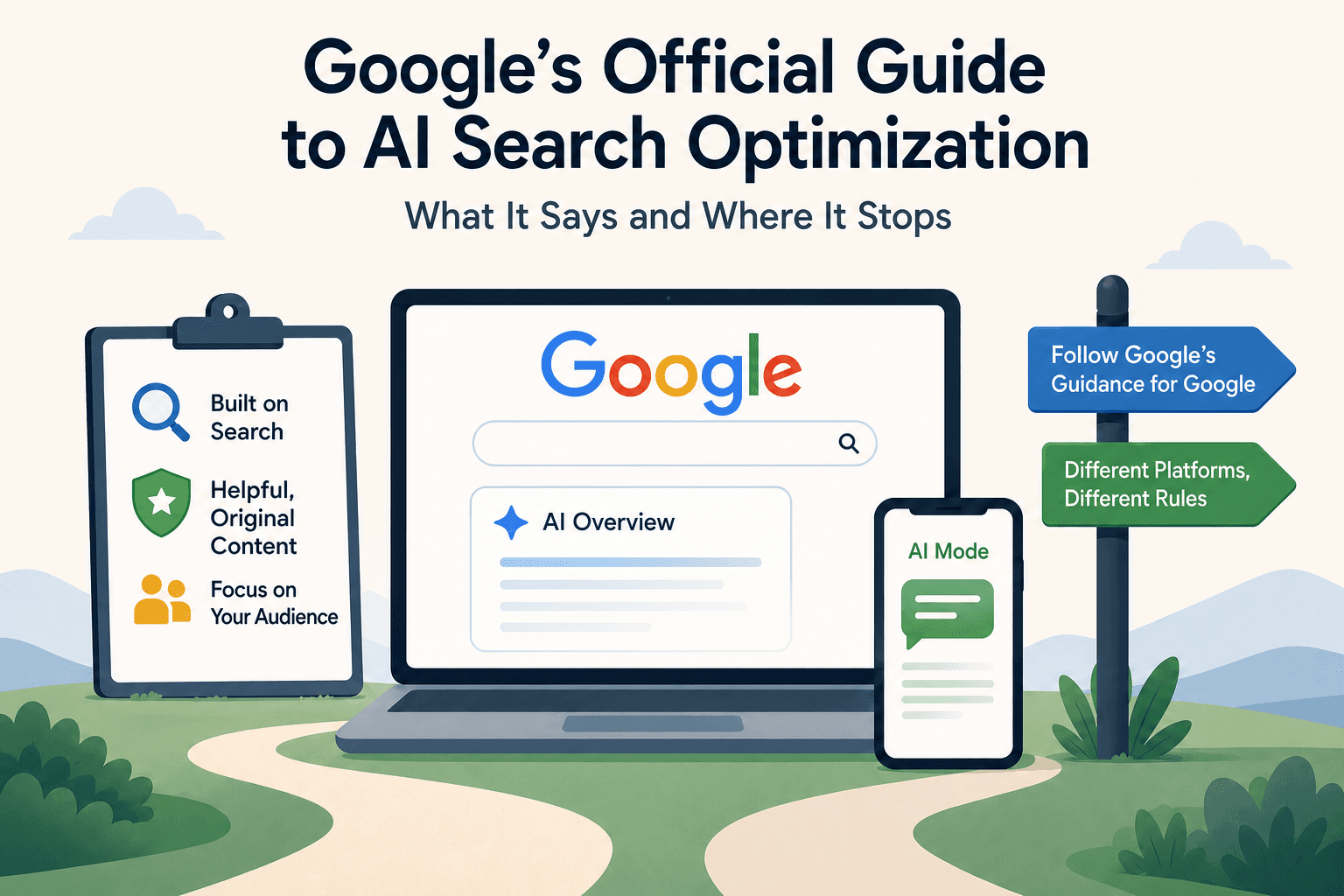
Google's guide is authoritative for Google, and brands should treat it that way. Meet the technical requirements. Clear the non-commodity content bar. Use the Search Console report. These will improve visibility in AI Overviews and AI Mode, which together reach more people than any other AI search surface.
What the guide does not do, and does not claim to do, is describe the rest of the landscape. ChatGPT, Perplexity, Claude, and Grok run on separate retrieval systems with their own crawlers, source preferences, and recency weighting. The overlap in what they cite is often low. Studies comparing ChatGPT and Perplexity on identical queries find the two surface different sources the large majority of the time, and Google's own AI Overviews and AI Mode diverge substantially from each other.
That is the practical takeaway. Follow Google's guide for Google, then build the rest of your strategy on how each platform actually behaves rather than assuming one company's documentation generalizes. One of these systems is now described from the inside. The others still have to be measured from the outside, and that measurement is where strategy starts.
Sentient AEO helps brands build and measure AI search visibility across ChatGPT, Google AI Overviews, and Perplexity, with additional coverage for Gemini, Google AI Mode, Grok, and Claude. If you're trying to understand where your brand stands in the AI answer layer, get in touch with us for an AEO audit: info@sentientaeo.com
Citations
-
Google's official guide to optimizing for generative AI features on Google Search, including RAG, query fan-out, non-commodity content guidance, mythbusting, and agentic experiences — Google Search Central: https://developers.google.com/search/docs/fundamentals/ai-optimization-guide
-
Google's guidance on evaluating third-party SEO advice — Google Search Central: https://developers.google.com/search/docs/fundamentals/third-party-seo
-
Google's scaled content abuse spam policy — Google Search Central: https://developers.google.com/search/docs/essentials/spam-policies
-
Generative AI performance report in Search Console — Google Search Console Help: https://support.google.com/webmasters/answer/16984139
-
Universal Commerce Protocol for agentic experiences — UCP: https://ucp.dev/latest/
-
Brands are 6.5x more likely to be cited via third-party sources than their own domains — PPC Land, What Ahrefs' Fake Brand Experiment Actually Proved: https://ppc.land/what-ahrefs-fake-brand-experiment-actually-proved-about-ai-search/
-
Brand's own website comprises only 5–10% of AI-referenced sources — McKinsey, New Front Door to the Internet: https://www.mckinsey.com/capabilities/growth-marketing-and-sales/our-insights/new-front-door-to-the-internet-winning-in-the-age-of-ai-search