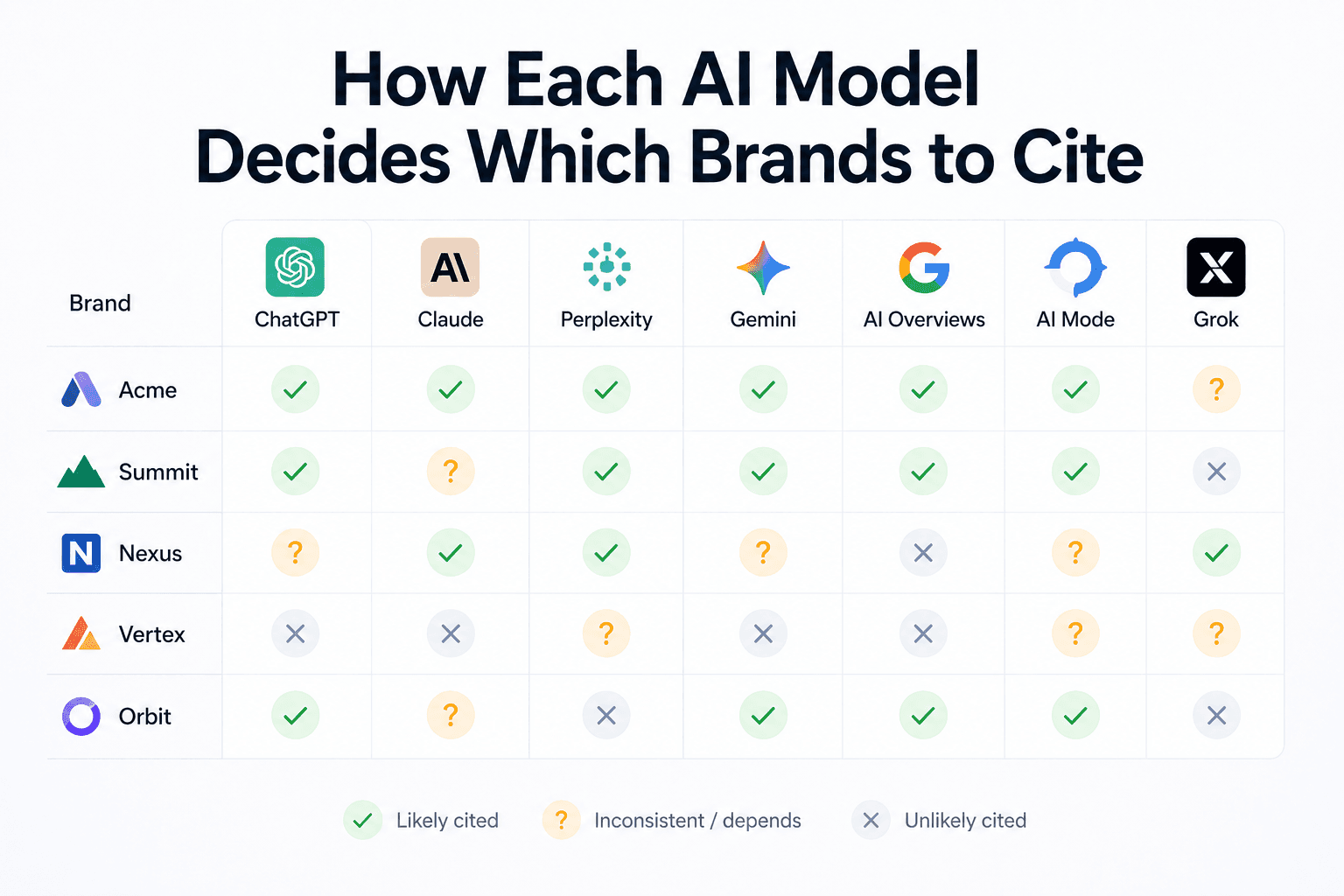
When marketing teams talk about "AI search," they often treat it as a single channel. It is not. ChatGPT, Claude, Perplexity, Gemini, AI Overviews, AI Mode, and Grok are seven distinct systems, each with different training data, different retrieval mechanisms, and different ways of deciding which brands to surface in an answer. A brand that shows up consistently in ChatGPT may be invisible in Grok. A brand cited by Perplexity may not appear in AI Overviews at all.
For brands trying to build AI visibility, understanding these differences is not academic. It directly shapes where to invest, what content to prioritize, and which signals matter most. Here is a high-level overview of how each major model decides which brands to cite, followed by the cross-cutting patterns that apply across all of them.
ChatGPT (OpenAI)
ChatGPT is the most widely used AI assistant and the one most marketing teams encounter first. It pulls from a combination of OpenAI's training data and live web retrieval through Bing's index when web browsing is enabled. The brands that appear most consistently in ChatGPT responses tend to share a few characteristics: strong presence on Wikipedia and other reference sources, frequent mentions across third-party publications and review platforms, and clear entity definition that helps the model associate the brand with specific categories and use cases.
ChatGPT also weights authoritative list mentions heavily. Being included in a "best of" or "top 10" article from a credible publication has an outsized effect on whether ChatGPT names a brand when asked for recommendations. Brand search volume is one of the strongest single predictors of inclusion.
Claude (Anthropic)
Claude takes a more conservative approach to source selection. It tends to favor authoritative, well-established sources and is less likely than ChatGPT or Perplexity to surface lesser-known brands without strong supporting evidence. When Claude has web access, it retrieves through Brave Search rather than Bing, which produces a different citation pattern than ChatGPT despite the surface similarity.
For brands, this means Claude rewards depth over breadth. A brand with strong, substantive coverage across a smaller number of credible sources will often outperform a brand with thinner mentions across many sources. Claude is particularly responsive to clear, factual brand information and disciplined entity signals.
Perplexity
Perplexity is built around live web search, and citations are central to how it presents answers. It shows the sources it draws from directly in the response, which means the surfaces that earn citations matter as much as the underlying brand mentions. Perplexity weights recency more heavily than other models, so freshly published content with clear authorship and structured information tends to perform well.
Perplexity is also notable for its outsized reliance on Reddit and community-driven sources. Brands with active, organic presence on Reddit and other discussion platforms often appear more frequently in Perplexity responses than their domain authority alone would suggest.
Gemini (Google)
Gemini is Google's consumer AI assistant and it draws on Google's broader knowledge graph and search infrastructure. Of the major models, Gemini is the most likely to favor brands with strong traditional SEO foundations: high-quality backlinks, structured data, established domain authority, and thorough Google Business and entity profiles.
For brands that have invested heavily in SEO over the years, Gemini visibility tends to follow more naturally than visibility in ChatGPT or Grok. The signals that matter for Google search and the signals that matter for Gemini overlap more than they do for any other model on this list.
AI Overviews
AI Overviews appear at the top of Google search results for a growing share of queries, currently around 25% according to recent research. Unlike standalone AI assistants, AI Overviews are tightly coupled to Google's search index. Brands cited in AI Overviews are almost always brands that already rank well in traditional Google results, with featured snippets and authoritative content being particularly strong predictors.
The implication for brands is direct: traditional SEO investment continues to pay off in AI Overviews more than in any other AI surface. This is the one environment where strong Google rankings reliably translate into AI visibility.
AI Mode
AI Mode is Google's conversational search experience, distinct from AI Overviews. It allows users to ask follow-up questions, refine queries, and have multi-turn conversations grounded in Google's index. AI Mode operates with more flexibility than AI Overviews and synthesizes from a broader set of sources, which means citation patterns differ significantly between the two even though they come from the same company. Recent analysis found only around 14% overlap in citations between Google AI Overviews and AI Mode.
Brands optimizing for AI Mode benefit from clear topical depth, comprehensive content coverage, and the kinds of structured FAQ and explainer formats that support multi-turn conversations.
Grok (xAI)
Grok is the most distinctive of the major models because of its tight integration with X. It draws from web content, but it also pulls from real-time public X posts, engagement patterns, and verified account activity. This means Grok visibility is shaped by social signal strength in a way that no other model on this list reflects.
For brands, Grok rewards an active, credible X presence: frequent posts, meaningful engagement, verified status, and being mentioned or referenced by other accounts in the relevant category. A brand that ignores X entirely will have a much harder time appearing in Grok responses than one with consistent organic presence on the platform, regardless of how strong its traditional web content is.
What every model has in common
Despite the differences, several signals matter across all seven systems. Brands serious about AI visibility should treat these as foundational, regardless of which model is the priority.
Entity clarity. Every AI model has to decide what your brand is, what category it belongs to, and what use cases it fits. The clearer and more consistent your entity definition is across the open web, the more reliably models will surface your brand for relevant queries. This means consistent positioning, structured data, complete reference profiles (Wikipedia, Crunchbase, LinkedIn), and unambiguous category language across your owned content.
Third-party validation. Across every model studied, a brand's own website is a small fraction of the sources AI engines reference. McKinsey research puts it at 5 to 10%. The remaining 90% or more comes from third-party publications, review platforms, industry databases, and community discussions. Brands that invest only in their own properties are optimizing a small slice of what actually matters.
Authoritative list mentions. Inclusion in credible "best of," "top 10," and category roundup articles is one of the most reliable ways to drive AI citations across multiple models. These mentions function as endorsements that AI systems weight heavily when generating recommendations.
Recency and freshness. Across most models, recently published and updated content outperforms older content, even when the older content is more comprehensive. Brands that maintain an active publishing cadence and refresh existing content regularly tend to sustain AI visibility better than those who treat content as evergreen and untouched.
Sentiment and framing. AI models do not just decide whether to mention a brand. They decide how to describe it. The framing AI uses is shaped by the dominant tone of the sources it draws from. Brands with active reputation management across review platforms, third-party coverage, and community discussions are not just more visible. They are more favorably described.
What this means for AI visibility strategy
The fragmentation across models is genuine and growing. Brands that treat AI visibility as a single optimization problem will leave significant ground uncovered. The brands that build durable visibility across all seven systems are the ones that invest in the cross-cutting fundamentals (entity clarity, third-party validation, list inclusion, freshness, and sentiment) while making targeted investments in the platform-specific signals that matter most for their category.
Sentient AEO's AI Visibility Audit covers ChatGPT, Gemini, and Perplexity. It produces a clear baseline of where a brand currently stands across these platforms and identifies the specific gaps and opportunities that should shape strategy. Knowing how a brand is performing across each model is the starting point. Building toward consistent visibility across all of them is the work.
Sentient AEO helps brands build and measure AI search visibility across ChatGPT, Claude, Gemini, and Perplexity. If you're trying to understand where your brand stands in the AI answer layer, get in touch with us for an AEO audit: info@sentientaeo.com
Citations
-
ChatGPT pulls from Bing's index when web browsing is enabled — Position Digital, 90+ AI SEO Statistics: https://www.position.digital/blog/ai-seo-statistics/
-
Authoritative list mentions drive 41% of AI citations; brand search volume strongest predictor — Onely, How ChatGPT Decides Which Brands to Recommend: https://www.onely.com/blog/how-chatgpt-decides-which-brands-to-recommend/
-
Perplexity's heavy reliance on Reddit, accounting for 40.1% of LLM citations — Position Digital, 90+ AI SEO Statistics: https://www.position.digital/blog/ai-seo-statistics/
-
AI Overviews appearing in approximately 25% of Google searches — Conductor 2026 AEO/GEO Benchmarks Report: https://www.conductor.com/academy/aeo-geo-benchmarks-report/
-
Only ~14% citation overlap between Google AI Overviews and AI Mode — Search Engine Land, LLM Optimization in 2026: https://searchengineland.com/llm-optimization-tracking-visibility-ai-discovery-463860
-
Grok integration with X and real-time social signal weighting — xAI About Grok: https://help.x.com/en/using-x/about-grok
-
Brand's own website comprises only 5–10% of AI-referenced sources — McKinsey, New Front Door to the Internet: https://www.mckinsey.com/capabilities/growth-marketing-and-sales/our-insights/new-front-door-to-the-internet-winning-in-the-age-of-ai-search
-
Ahrefs: brands 6.5x more likely to be cited via third-party sources than own domains — PPC Land, What Ahrefs' Fake Brand Experiment Actually Proved: https://ppc.land/what-ahrefs-fake-brand-experiment-actually-proved-about-ai-search/