Sentient AEO
TeamFeaturesPricingCase StudiesInsightsFree ToolsContact
Back to Insights

Agentic Commerce Is Here. The Brands That Get Discovered Will Win

Mar 24, 2026Peter Zaleski

Something significant happened in ecommerce this month that did not get enough attention outside of retail trade publications. OpenAI quietly shut down Instant Checkout, the feature it launched last fall that let...

Agentic Commerce Is Here. The Brands That Get Discovered Will Win

Something significant happened in ecommerce this month that did not get enough attention outside of retail trade publications. OpenAI quietly shut down Instant Checkout, the feature it launched last fall that let users buy products directly inside ChatGPT without ever visiting a retailer's website. Walmart, Etsy, and Shopify had all signed on. Shopify's president called it the "new frontier" for online retail. Within months, the whole model collapsed.

The reasons matter. And so does what comes next.

What agentic commerce is and why it changes everything

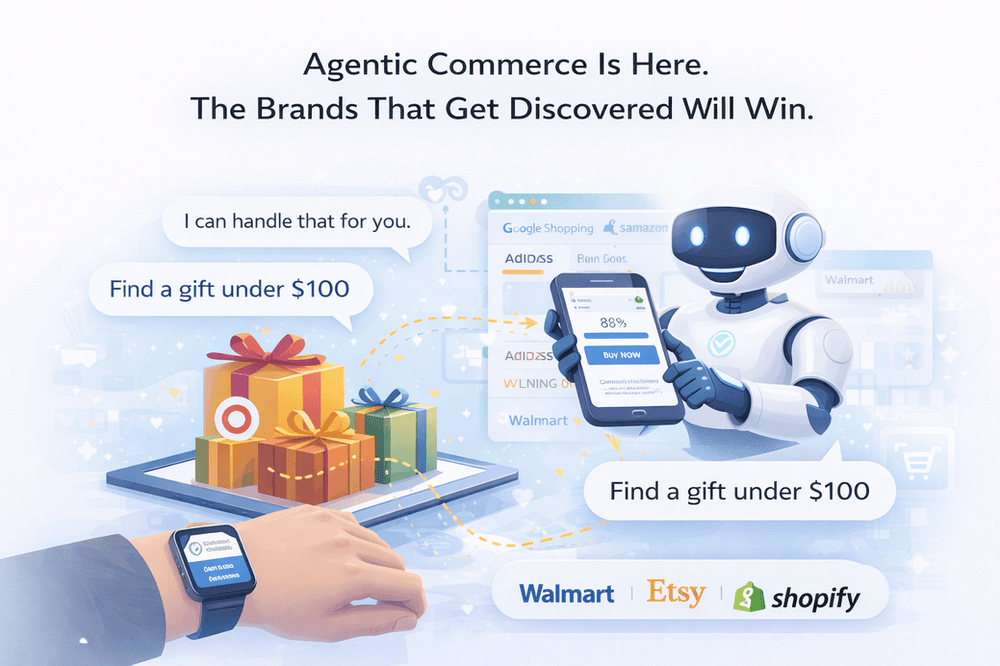
Agentic commerce is the idea that AI systems do not just help users find products. They complete the purchase on their behalf. A user asks ChatGPT to find a gift under $100, the AI selects a product, confirms shipping details, and processes the transaction, all without the user visiting a single website.

OpenAI built its version of this through the Agentic Commerce Protocol, developed with Stripe. The vision was straightforward: AI as a personal shopper that removes friction from discovery to checkout in a single conversation. For brands, it represented both an opportunity and a threat. Get discovered by the AI, and you reach a buyer at the exact moment of intent. Get overlooked, and you do not exist in that transaction at all.

Google launched its own version in January 2026, the Universal Commerce Protocol, co-developed with Shopify, Etsy, Wayfair, Target, and Walmart, with backing from Visa, Mastercard, and Stripe. Amazon is taking a different path entirely, building AI commerce inside its own ecosystem through tools like its Rufus shopping assistant and "Buy for Me" agent, while actively blocking outside AI agents from accessing its site.

The infrastructure for AI-mediated commerce is being built right now. That is not a prediction. It is already deployed and already shaping which brands get considered.

Why Instant Checkout failed, and what it actually reveals

Walmart's internal data told a clear story. Conversion rates for purchases completed inside ChatGPT were three times lower than transactions completed on its own website. Daniel Danker, Walmart's EVP of product and design, called the in-chat experience "unsatisfying" and confirmed the company is moving away from it. Forrester analyst Emily Pfeiffer noted that as of last month, only around 30 Shopify merchants had successfully onboarded despite OpenAI promising access to over a million. The process was arduous and the system was prone to errors.

Gartner analyst Bob Hetu summed it up plainly: OpenAI "underestimated how difficult the enablement of transactions was going to be."

But here is what the failure of Instant Checkout does not mean: it does not mean agentic commerce is going away. It means the transaction layer was not ready. The discovery layer already is.

OpenAI confirmed it is shifting focus to product discovery and search, where user engagement has been significantly stronger than transaction completion. ChatGPT was already the third most-used tool for product research among US and UK online adults in Forrester's February 2026 Consumer Pulse Survey, behind only Google and Amazon. Users are already going to AI to decide what to buy. The checkout just needs to happen somewhere more familiar.

The new model reflects this. Walmart is embedding its Sparky AI assistant directly into ChatGPT. Shopify is routing purchases back to merchant storefronts rather than completing them natively in chat. Etsy is building a dedicated ChatGPT app. The pattern across all of them is the same: AI handles discovery and recommendation, the brand handles the transaction. Discovery in AI. Conversion on your own terms.

What this means for any brand selling through digital channels

The failure of Instant Checkout was a conversion problem. What it exposed, however, is a visibility problem that applies to every brand regardless of whether they were part of the experiment.

When a user asks an AI to recommend a product in your category, three or four brands get mentioned. The rest do not exist in that moment. That selection happens before the user visits any website, before they see any ad, and before any owned content has a chance to influence them. The AI has already made the shortlist.

That shortlist is not random. It is shaped by how prominently a brand appears in the sources AI systems trust, including third-party publications, review platforms, industry databases, and user-generated content, and by how clearly the brand's positioning, products, and differentiation are understood by the models doing the selecting.

Brands that invest in AI visibility now are securing a position in that shortlist while the category is still being established in the models' understanding. Brands that do not are ceding the discovery layer entirely and hoping the transaction layer will eventually bail them out. The Walmart data suggests it will not.

The shift to app-based checkout and merchant-controlled transactions is genuinely good news for brands. It means AI handles the hard part, reaching a buyer at the exact moment of high-intent research, while the brand retains control of the experience that converts. That is a better division of labor than Instant Checkout was attempting. But it only works if the brand is in the AI's answer in the first place.

The practical implication

Agentic commerce in its current form is a two-stage process: AI discovery followed by brand-controlled conversion. Brands that optimize for the first stage will benefit disproportionately from the second. Brands that focus only on their own websites, their own checkout flows, and their own SEO rankings are optimizing stage two while leaving stage one entirely to chance.

The question worth asking right now is a simple one: when a prospective customer asks an AI to recommend a brand in your category, do you appear? And if you do appear, how are you described?

Those two questions are what a serious AEO practice answers. And in a world where AI is already mediating product discovery for hundreds of millions of users, they are becoming the most important questions in digital marketing.

The brands that are actively building AI visibility right now have a structural advantage that compounds over time and is difficult for late movers to close quickly. AI systems learn what brands are from the accumulated weight of sources referencing them consistently. A brand that builds clear, credible, third-party coverage across the publications and platforms AI systems weight heavily today is training the models on its positioning before the competitive set is established. That window closes as more brands recognize the same opportunity.

The visibility signals that matter most in AI discovery are not the same ones that drive traditional search performance. Third-party editorial coverage, review platform presence, brand mention frequency in industry databases, and the consistency of positioning across sources AI systems trust all carry more weight than a company's own website content. For most brands, these signals are either absent or inconsistent, which is exactly why the shortlist for a given category is often dominated by a handful of names that got there early.

Understanding where you stand on those signals is the starting point. An AI Visibility Audit maps where your brand appears across the queries that matter in your category, how it is described when it does appear, and where the gaps between you and the brands currently dominating the AI shortlist are largest. That baseline turns AI visibility from an aspiration into a trackable, improvable program with clear ownership and measurable outcomes. And in a category where agentic commerce is already shaping which brands get considered at the moment of purchase intent, the audit is not preparation for future change. It is a direct response to change that is already well underway.

Sentient AEO helps brands build and measure AI search visibility across ChatGPT, Claude, Gemini, and Perplexity. If you're trying to understand where your brand stands in the AI answer layer, get in touch with us for a an AEO audit:  info@sentientaeo.com

Citations

  1. Walmart: ChatGPT checkout converted 3x worse than website — Search Engine Land, March 19, 2026: https://searchengineland.com/walmart-chatgpt-checkout-converted-worse-472071

  2. OpenAI's Instant Checkout: launch announcement, Agentic Commerce Protocol — OpenAI: https://openai.com/index/buy-it-in-chatgpt/

  3. OpenAI shifts away from Instant Checkout toward app-based model — CNBC, March 20, 2026: https://www.cnbc.com/2026/03/20/open-ai-agentic-shopping-etsy-shopify-walmart-amazon.html

  4. Only ~30 Shopify merchants onboarded despite promise of over a million; Forrester analyst on onboarding difficulty — CNBC, March 20, 2026: https://www.cnbc.com/2026/03/20/open-ai-agentic-shopping-etsy-shopify-walmart-amazon.html

  5. Walmart's Sparky AI assistant to be embedded in ChatGPT and Google Gemini — CNBC, March 20, 2026: https://www.cnbc.com/2026/03/20/open-ai-agentic-shopping-etsy-shopify-walmart-amazon.html

  6. Google Universal Commerce Protocol launched at NRF, January 2026, co-developed with Shopify, Etsy, Wayfair, Target, Walmart — PYMNTS: https://www.pymnts.com/artificial-intelligence-2/2026/what-happens-to-stores-when-ai-agents-do-the-shopping/

  7. Amazon blocking outside AI agents, building commerce inside own ecosystem via Rufus and "Buy for Me" — PYMNTS: https://www.pymnts.com/walmart/2026/walmart-shuts-down-agentic-commerce-with-openai/

  8. ChatGPT third most-used product research tool among US and UK online adults — Forrester Consumer Pulse Survey, February 2026: https://www.forrester.com/blogs/power-couple-openai-amazon-may-have-just-won-consumer-agentic-commerce/

  9. OpenAI and Amazon strategic partnership, $50 billion investment — Forrester: https://www.forrester.com/blogs/power-couple-openai-amazon-may-have-just-won-consumer-agentic-commerce/

Sentient AEO

AI Search Optimization software for teams improving how their brand appears across answer engines.

Site

HomeTeamFeaturesPricingCase StudiesInsightsFree ToolsContact

Legal

Privacy PolicyTerms of UseDisclaimerCookie PolicyAI Information

Contact

info@sentientaeo.com

(215) 681-8824